
Custom PEEK Seals & Sealing Rings
Drawing-based PEEK seal components for static and selected dynamic assemblies. Performance depends on the full seal design, operating media, pressure, temperature, motion and mating hardware.
Upload Drawing for Quote →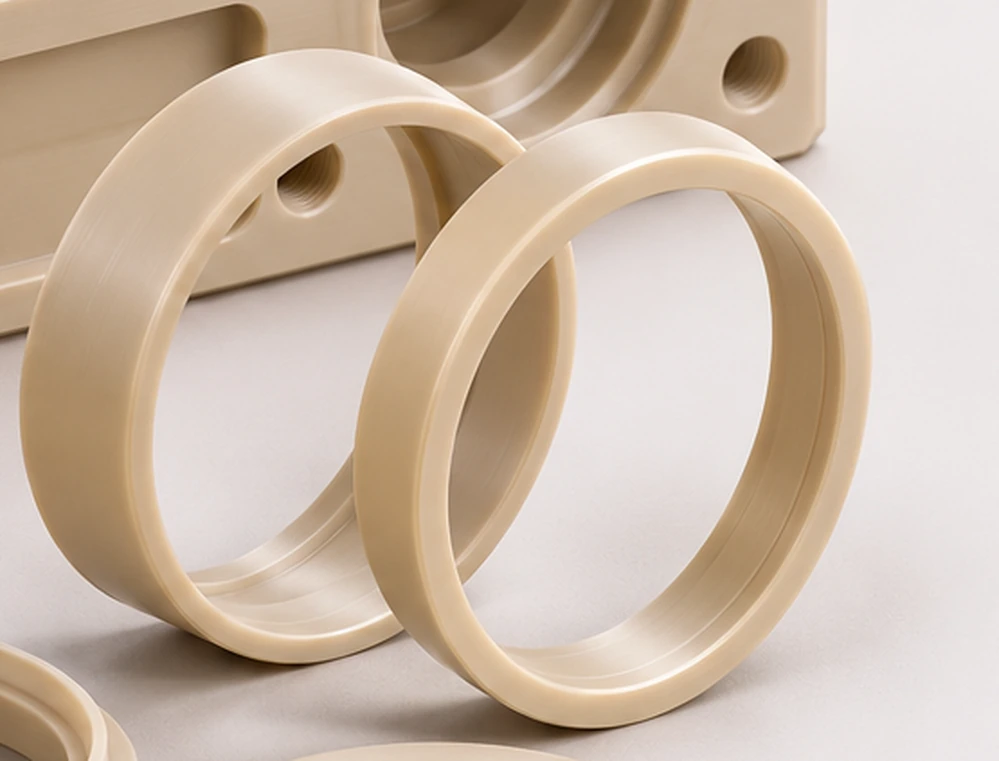 Illustrative product rendering
Sealing components, not generic wear parts.
This page focuses on parts whose primary design task is to support a specified sealing interface. Valve seats and guide rings are related machined parts, not substitutes for a seal profile.
Flat seal ring / washer profile
Define flatness, section, contact face, compression design and any mating gasket.
Stepped / custom-profile ring
Confirm lip, shoulder, groove and installation orientation from a section drawing.
Application-specific seal geometry
Send an approved profile; avoid assuming the same geometry suits static and dynamic duty.
Start by identifying the motion and sealing duty.
A machined component that meets dimensional tolerance is not automatically qualified to meet leakage, wear or life requirements.
| Application | Information needed |
|---|---|
| Static sealing | Confirm mating face, assembly compression, pressure differential, media compatibility, surface finish and required leak test. |
| Reciprocating duty | Specify stroke, speed, pressure reversal, lubrication, shaft or bore finish and intended primary sealing principle. |
| Rotary duty | Define speed, runout, shaft finish, thermal effects, lubrication and permissible leakage. Requires application-specific validation. |
| Special service | For medical, aerospace or food-contact applications, identify required compliance and testing; none is implied by PEEK material alone. |
Five inputs that determine the sealing conversation.
Process media
Chemical identity, concentration, additives, cleaning media and exposure time.
Pressure
Operating / peak pressure, differential direction, cycles and potential pressure reversal.
Temperature
Continuous and peak operating temperature, start-up / shutdown and thermal cycles.
Motion and speed
Static, reciprocating or rotary duty; stroke, speed, frequency and lubrication.
Mating hardware
Groove dimensions, shaft/bore fit, surface roughness and counterpart materials.
Acceptance criteria
Leak rate if required, dimensional checks, finish, life target and testing responsibilities.
Send a section drawing, not just OD × ID.
At minimum, the quotation should distinguish the nominal ring dimensions from its assembled sealing function.
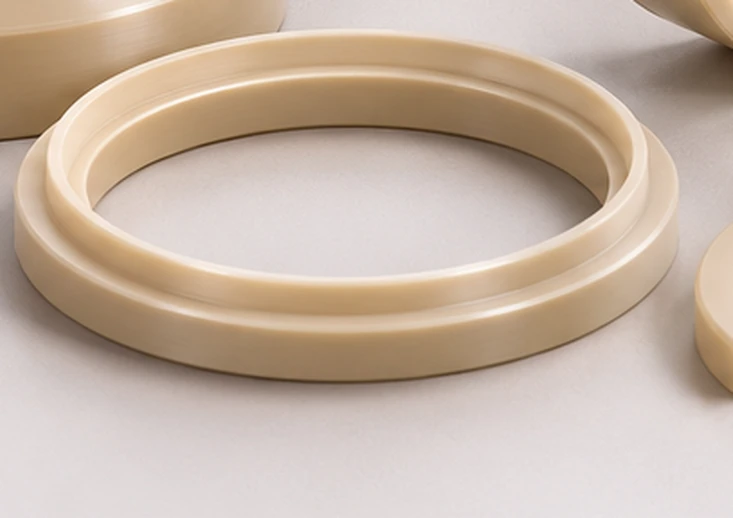
- Inner/outer diameter and section profile
- Axial height, lips, grooves and edge details
- Functional face finish and datum definition
- Temperature, media, pressure and assembly conditions
- Leakage test method and acceptance threshold, if applicable
Static, reciprocating and rotary sealing are different procurement problems
A machined PEEK part may act as a rigid sealing component, support or wear element depending on the system. A profile drawing alone does not prove leak-tight performance.
| Duty | Buyer application data | Design-review issue | Acceptance evidence |
|---|---|---|---|
| Static | Face/radial arrangement, media, pressure, temperature, tightening or compression. | Contact surface, groove fill, thermal mismatch and how sealing force is provided. | Drawing inspection plus any required assembly leak test. |
| Reciprocating | Stroke length/frequency, rod/bore finish, lubrication, pressure direction. | Motion-induced wear, extrusion risk, friction and supporting element interactions. | Functional test agreed for the full sealing system. |
| Rotary | Shaft speed, runout, lubrication, heat and counterface condition. | Frictional heating, wear, contact stability and material suitability. | Temperature/wear/leakage testing if required by design. |
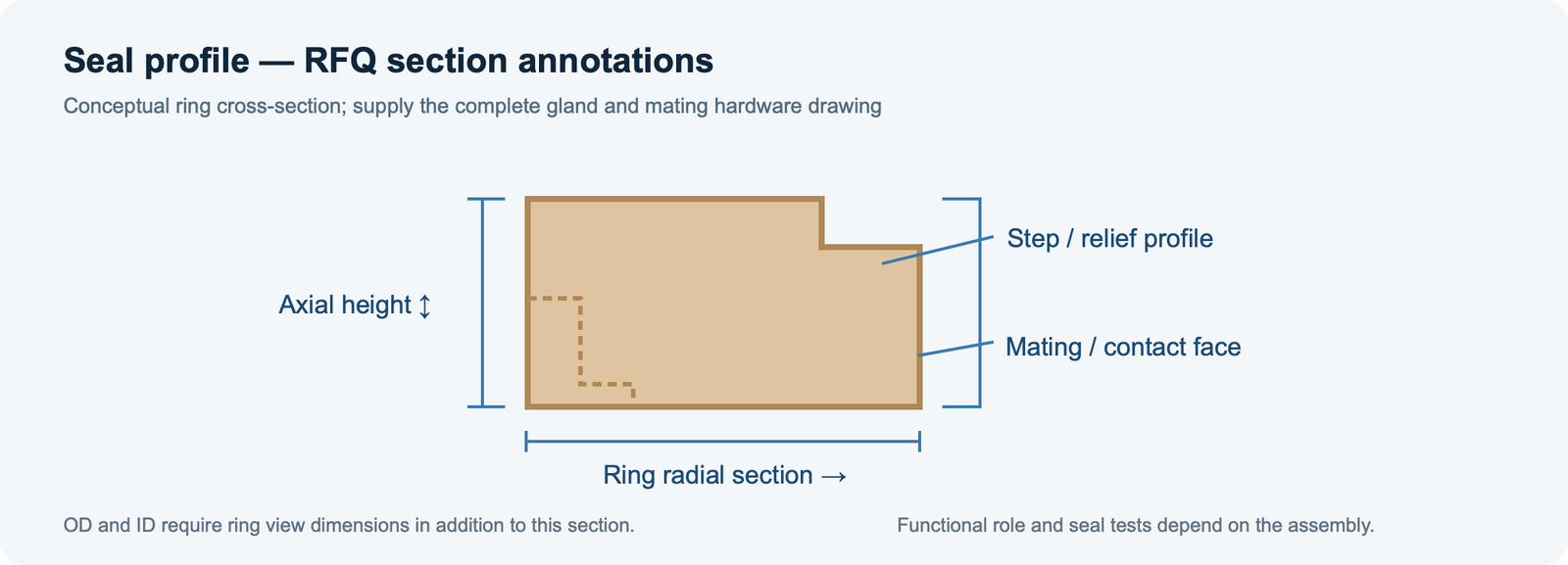
Section drawing: define the profile, not only OD × ID
Illustrative profile annotations for a component RFQ. Final geometry and performance require application-specific validation.
| Profile field | Why it matters |
|---|---|
| ID / OD and axial width | Controls fit, assembly space and available profile section. |
| Contact or step geometry | Locates functional contact areas and defined edge conditions. |
| Groove & mating surface | Relates the ring to clearance, finish, runout and hardware datums. |
| Media, temperature, pressure, motion | Determines whether material selection and functional testing require further engineering. |
PEEK seal operating-condition sheet.
Complete the prompts below before requesting an application-specific sealing component.
Required application details
Frequently asked seal-design questions.
Can a machined PEEK ring be used as a primary seal?
Only where the complete seal geometry, mating hardware and operating conditions support that function. A material name or finished dimension alone does not establish sealing performance.
Which operating parameters are most important?
Media, pressure direction and peak value, temperature range, duty cycle, motion, mating surface and leakage acceptance criteria.
Do you need our existing seal sample?
A dimensioned drawing and section view are preferred. An existing sample can help identify profile details, but should be checked against the approved assembly design.
Can the same PEEK seal profile work in static and dynamic applications?
Do not assume interchangeability. Dynamic service adds friction, wear, heat generation and lubrication considerations that require design validation.