
PEEK Tubes & Hollow Bars
Define outside diameter, bore diameter, wall thickness and cut length for PEEK tubes and hollow stock used in sleeves, bushings and machined ring parts.
Request PEEK Tube Quote →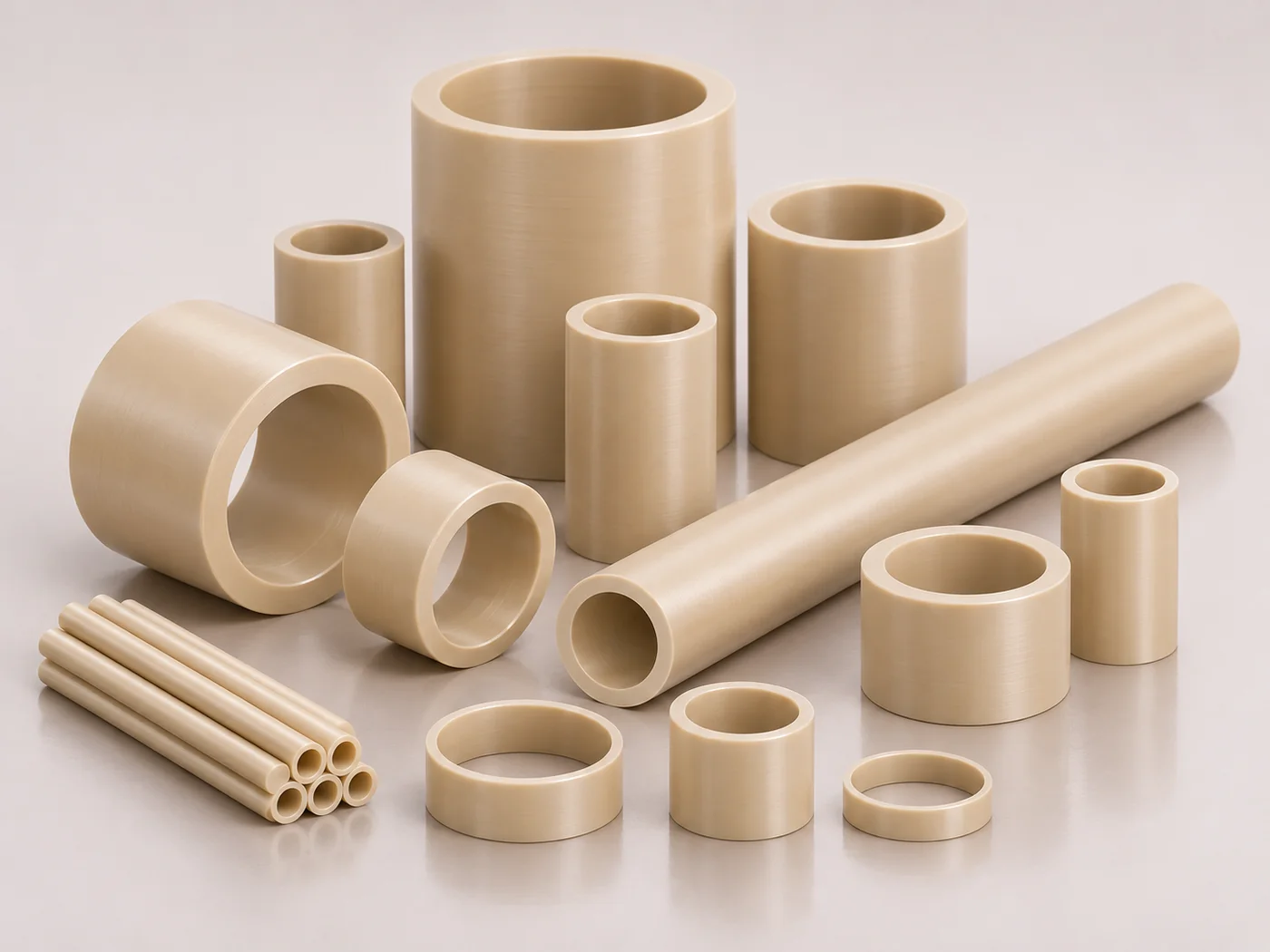 Illustrative 3D product rendering
Hollow stock for rings, sleeves and bushing blanks.
Identify the product form, required grade and intended use before confirming material selection or production scope.
Define hollow stock by OD, ID and usable length.
PEEK tubes and hollow bars are often procured as near-net raw stock for ring, sleeve and bushing machining. Define the actual bore and external sizes. Industrial hollow stock should not be conflated with small-bore analytical HPLC tubing.
- Thick-wall hollow rods for subsequent turning and machining
- Tube cut lengths and custom bore requirements
- Material grade and method selected for the application
Illustrative product renderWhat to include in the purchase specification.
Confirm the required dimensions, material grade and quantity for an accurate quotation.
| RFQ input | What to specify and why it matters |
|---|---|
| Outside diameter (OD) | Required nominal outer diameter, tolerance and machining stock allowance. |
| Inside diameter (ID) | Bore diameter and allowable offset; provide actual mating fit if it is a finished tube. |
| Wall thickness (t) | For a concentric section, nominal wall = (OD − ID) / 2; minimum wall depends on actual eccentricity and tolerances. |
| Length & cut finish | Cut length, end squareness, straightness, quantity and packaging for transport. |
| PEEK material | Unfilled / GF30 / CF30 as review options, with exact grade and processing route to be confirmed. |
| Application | Fluid contact vs structural bushing blank, operating temperature, pressure, any inspection and paperwork requirements. |
Dimensions, grades and availability are confirmed for each quotation.
Outside diameter, bore and calculated wall thickness.
Use this dimension sketch to make your first inquiry complete. Confirm all tolerances, fit requirements and acceptance criteria on your own drawing.
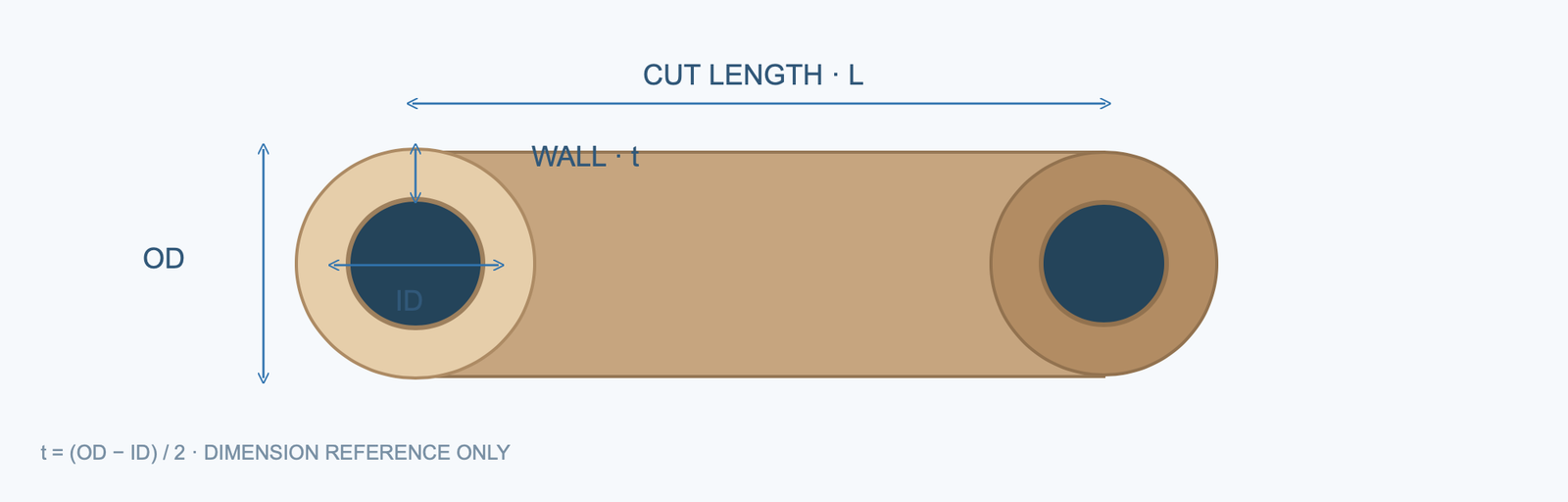
Nominal geometry only; ignores eccentricity and tolerance stack-up.
Optional tolerance estimate assumes independent symmetric OD/ID diameter limits and perfect concentricity. The result is not a minimum local wall guarantee: eccentricity, ovality, taper and measurement uncertainty require separate analysis.
Hollow stock saves material only when the geometry fits.
Product-specific guidance to help engineers and buyers avoid a quotation that looks attractive but is technically incomplete.
Reduce material removal where appropriate
A suitable bore can save material in annular machining, but stock size, geometry and material properties must be checked.
Use OD and ID—not nominal pipe size alone
Two tubes with the same outer diameter may have very different usable wall and machining allowance.
Stock condition can change selection
Extrusion, molding and machining are different routes. The exact raw-stock manufacturing method must be confirmed for a purchase order.
Concentricity and finished bore
Ask for eccentricity / concentricity checks when the finished part depends on uniform wall thickness.
Industrial hollow bar vs analytical tubing
Precision fluidic HPLC tubing has different dimensions, cleanliness and acceptance requirements; it is not assumed here.
Cut length, packing and traceability
Quote by OD × ID × length, grade and quantity. Define any custom boring or end finishing separately.
Hollow bar vs precision tubing: clarify the intended use
An industrial machining blank and a small-bore fluidic tube have different sourcing and validation requirements. The page targets machinable hollow stock.
| Intended use | Key parameters | Needed evidence |
|---|---|---|
| Machining hollow blank | OD, ID, usable length, stock allowance, grade. | Stock availability and machinability review before quoting. |
| Finished ring / sleeve | Final bore/OD, wall, concentricity, datum and finish. | Finished-component drawing and agreed inspection. |
| Fluid transfer / analytical tubing | Small-bore ID tolerance, pressure, cleanliness, chemical media, connection style. | Separate product-specific capability, cleaning and functional evidence; not implied here. |
Tube / hollow bar dimension checklist.
Use this checklist to prepare your product-specific RFQ.
Check before sending your inquiry
References for material selection and stock-shape specifications. Confirm the required grade, dimensions and availability for your order.
Frequently asked questions.
Direct answers to common procurement decisions and engineering details.
What dimensions are needed for a PEEK tube quote?
Specify OD, ID, cut length, grade and quantity. State wall thickness or relevant tolerances if the geometry is critical.
How is nominal PEEK tube wall thickness calculated?
For a concentric ring section, nominal wall thickness equals (OD − ID) ÷ 2. Real minimum wall must account for dimensional tolerances and eccentricity.
Is PEEK hollow bar the same as HPLC tubing?
No. Industrial hollow bar for turning and fine-bore analytical tubing differ in scale, cleanliness, surface and validation requirements.
Can PEEK tube stock be used for back-up rings?
It can be considered as a starting stock form where grade, geometry and processing allow. Finished ring properties still require drawing and gland review.